

Landing pages are a critical part of selling products, getting subscriptions, and,ultimately, attracting customers’ attention online. Perfecting your landing pages can mean outperforming competitors, and maximizing conversions and sales. Your landing page copy is a key part of this. Let’s explore some strategies for optimizing persuasive copywriting for landing pages.
8 Persuasive Copywriting Strategies for Better Landing Pages
First, what do we mean by landing pages? And what do we mean by copy?
A landing page, also called a squeeze page, static page, or lead capture page, is a web page dedicated to a particular marketing goal. Usually, the goal is to persuade a potential customer to make a purchase, sign up for updates, or download a lead magnet, such as a downloadable guide related to a product or service. All elements on the page, from the text to the images and videos, testimonials and reviews, to the form on the page, and more, play a role in how customers perceive the page.
Persuasive copywriting refers to the text, or copy, on the page, and making it more convincing. Not all copy is created equal, and different types of copy are designed for different things. There are a few different ways to improve persuasive copywriting for landing pages. In this blog post, we’ll explore a few of these different strategies.
 1. Use an Active Voice
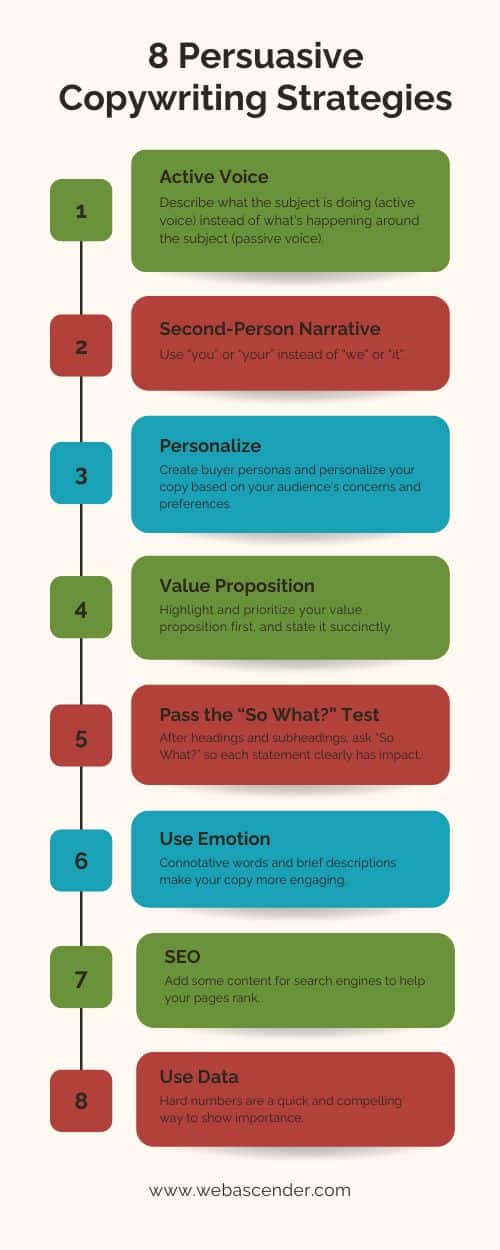 1. Use an Active Voice
An active voice is helpful for most web copy, but it’s especially helpful for landing pages. Landing pages are generally brief and customers are likely to scan them, so an active voice will help each word make more impact.
What is an active voice? An active voice directly describes the subject of a sentence, while a passive voice describes what happens around the subject. Consider the following two statements, and which would be more persuasive on a landing page.
Supercharge your fitness with the Full-Body Workout Booklet
Your fitness can be supercharged with the Full-Body Workout Booklet
Not only is the first statement, in the active voice, shorter, but the verb “supercharge” is more exciting than “can be supercharged.”
Changing the passive voice is easy to do during the proofreading process; find incidents of “to be” or versions of it, and see if you can make the statement more succinct.
2. Second-Person Inspires Action
If you’re telling a story about yourself, you’d use the first-person narrative, making “I” the subject of the story. But landing pages are about your customer. Talking directly to your customer using the second-person narrative, making “you” the subject, will create a faster connection. Consider the following examples.
The Calendar Organizer App is a Calendar’s Best Friend
Our Calendar Organizer App is Made to Simplify and Streamline
Simplify Your Schedule with the Calendar Organizer App
The first statement is somewhat vague. It’s unclear who benefits from the Calendar Organizer App, and who should care. The second statement focuses on the creators of the app using “our”, and doesn’t state why the reader should care. The last statement connects with the audience by referring to “your schedule” and stating what the Calendar Organizer App can do.
You don’t have to use “you” and “your” in every sentence on your landing page. Third- and first-person narratives can also be helpful. However, a second-person voice can be great for headlines, CTA’s, and first-sentence hooks, to grab your customer’s attention.
3. Personalize for Your Audience
A clear understanding of your target audience will help you customize your copy for that audience. Create a buyer persona to identify more characteristics of your audience, such as their age, types of media they enjoy, their concerns, and whether they’d be likely to respond to a casual or formal voice.
Once you know your audience, consider how you could craft your landing page copy to connect with them. Consider what problems they’re trying to solve, and how you might leverage this in your copy. Take a look at the types of media they’re likely to read, and consider how you could emulate this. For example, younger audiences will probably resonate with a more casual tone using more slang and less formality. However, older audiences may find this off-putting and overly familiar.
4. Prioritize Your Value Proposition
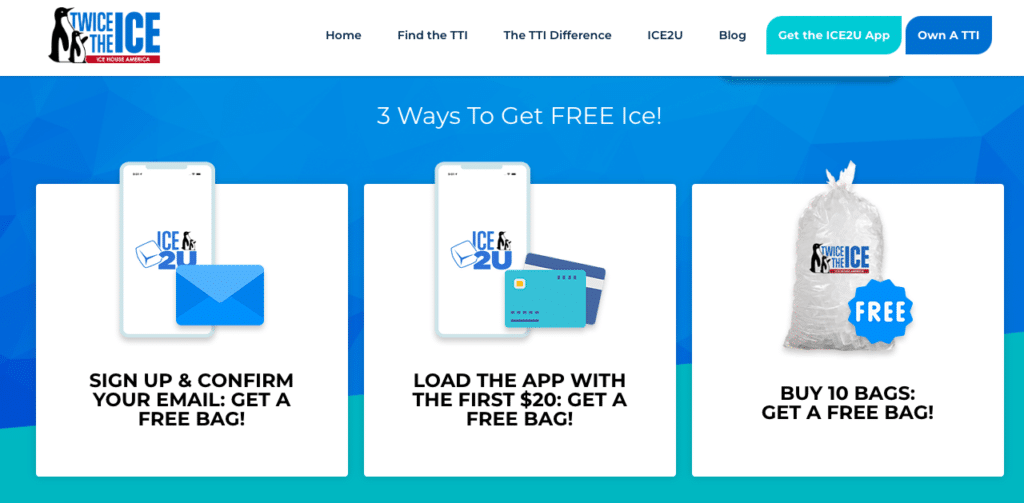
Twice the Ice highlights the benefits of their ICE2U app on their landing page.
Once a customer has arrived at your landing page, they probably have a goal in mind. They should be looking to make a purchase, download a guide, schedule a consultation, or complete another task. This means they’re unlikely to spend a long time reading lots of copy. So, it’s important to make your copy short, and prioritize your value proposition.
To craft persuasive landing page copy that’s also short and impactful, it’s helpful to first make a list of all the things you could say. Then, you can whittle the list down to the most important elements, and put the right language behind them.
To create a list of elements for your landing page, consider the following elements of your product, service, or lead magnet:
- – What the product or service is and does
- – Its primary benefits and advantages
- – Problems your product or service can solve
- – Secondary features or other advantages
With this list collected, arrange them from most important to least important, from your customer’s perspective. Then, describe each one in the most succinct way possible. Finally, use these persuasive copywriting strategies to make the language more exciting and actionable.
5. Apply the “So What?” Test
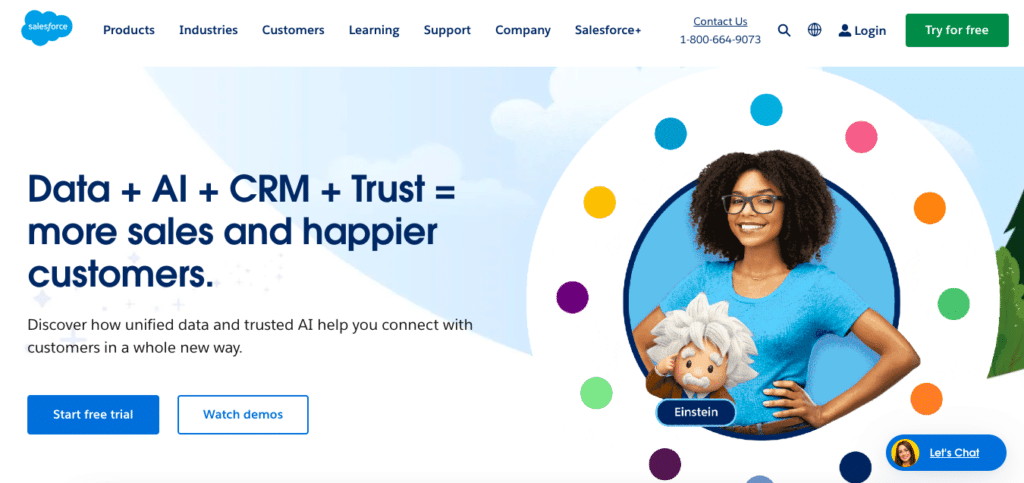
Salesforce’s landing page passes the So What? test with “more sales and happier customers.”
The “So What?” test is a helpful strategy for more persuasive copywriting on landing pages. This test will make each of your statements more impactful. It can also help you pare down your content to its most important elements.
The “So What?” test asks why a statement is important or why the reader would care. Looking at each statement, particularly for headings, simply ask “So What?” If the statement doesn’t clearly show a benefit, consider how you could reword it.
Let’s take a look at an example heading and subheading for a hypothetical cloud storage service.
Easy, Flexible Cloud Storage: 100 GB storage for any pictures, videos, or documents
So What?
While this statement explains what the service offers, it doesn’t clearly state how this helps the customer. Why is this storage for these items important? What does it mean for the customer? Since this isn’t clear, the statement is a bit dry.
Let’s try again.
100 GB of Cloud Storage: Never lose a precious photo or important document
So What?
The impact of the cloud storage service is more clear; customers won’t lose the photos or documents that are important to them. The statement introduces consequences—losing important files—which makes it more impactful. It also explains essentially the same information, while using less space overall. You don’t have much space for headings and subheadings, so every little bit counts!
6. Use Emotion (Where Appropriate)
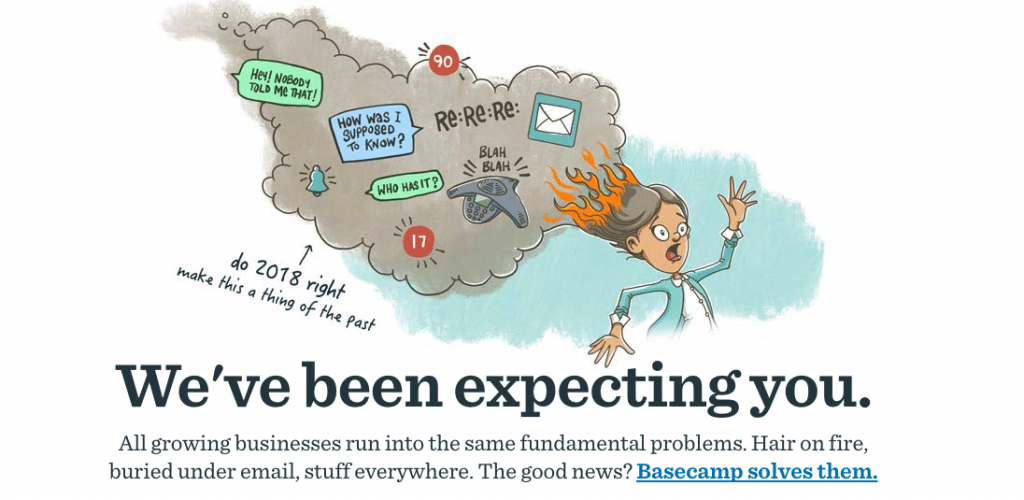
Basecamp uses strong, connotative language and imagery to grab their prospective customers’ attention.
In the previous example, you may have noticed that the second statement used an emotional appeal; never lose a precious photo. The words “lose” and “precious” both carry some emotional connotation. Using a bit of emotional language can make your content less dry and more impactful. However, it’s important to use this strategy carefully.
Consider your product and your audience when using emotionally-charged words. For example, if you’re selling forklifts to businesses, many emotional appeals will be unprofessional or irrelevant. However, if you’re selling children’s books to new parents, emotional appeals will be more applicable.
Let’s take a look at a few example headings on landing pages for different businesses, and why they might or might not be effective.
- – “Buy Better Forklifts! Low-quality forklifts mangle employees and destroy goods!” This is likely to be perceived as overly dramatic and inappropriate.
- – “Buy Better Forklifts! High-quality forklifts protect employees and move goods faster.” This is a gentler, more professional emotional appeal.
- – “Every Parent’s Favorite Book: Books that help your child learn to read.” Though a child’s literacy is important to parents, the language isn’t very descriptive or impactful.
- – “Give Your Child the Best Start: Books proven to help children read sooner.” The image of a great start for a child, and the assurance that the books are “proven to help” creates a stronger emotional appeal.
7. Design for Search Engines and People
The art of persuasive copywriting in landing pages doesn’t just include human readers. A critical part of an effective landing page is written for search engine algorithms, which decide whether or not a page appears when a user enters a relevant search. If your page doesn’t appear in front of potential customers, it won’t matter how effective the language is. This means SEO copywriting is just as important as copywriting for humans.
A variety of SEO tips can make your landing page more appealing to search engines. Remember that there are off-page and on-page SEO elements to consider, as well as technical SEO elements, and text-related. Here’s an overview of text-related tips to keep in mind:
- – Informative: In general, search engines consider short pages to be less informative, and therefore less valuable, to readers. Though landing pages are meant to be skimmed, it can be helpful to include a longer, more informative section lower down the page. This probably won’t distract customers, but will help inform search engines.
- – Keywords and concepts: Consider what keywords or phrases a customer might enter in a search to find your page. Also, consider what concepts might be important to explain. Use these keywords and concepts in the informative paragraph mentioned previously.
- – Formatted properly: Your headings, subheadings, and paragraphs should be formatted properly, so search engines can see that your text is organized in a way that is easy to read.
- – Linked: Pages with links to outside sources tend to perform better than those without. Additionally, pages with external links from other sites tend to perform better. Consider how you might build up the pages’s backlink profile, and use outbound links thoughtfully on the page.
8. Use Numbers and Statistics
Numbers, statistics, and hard data are compelling to most customers. While emotional language, descriptions, and value propositions are also important, consider how you might also incorporate data into your landing page. This might include any of the following:
- – People helped: If your product or service helps people, how many people have you helped?
- – Hours saved: For products or services that help users save time, how many hours have you saved?
- – Products sold: Have you sold thousands, or millions of products already? This can be powerful.
- – Reviews gathered: How many happy customers have you served? Show reviews on your landing page to let people know.
- – Years in business: Long-standing businesses often generate more trust. Tell your customers how long you’ve been around.
- – Money saved: If your product saves people money, how much have you saved them?
- – Charitable contributions: If you make donations with each purchase, how much have you donated?
- – Countries active: Do you ship to, or have stores in, multiple countries? A worldwide presence can be impressive for many customers.
- – Sustainable achievements: Have you saved pounds of plastic from a landfill, saved large amounts of carbon emissions, reduced gallons of wastewater, or another sustainable achievement? Show it off.
Extra Tips to Optimize Your Landing Page
Persuasive copywriting for landing pages is one important part of the pages’ impact, but a few other strategies can help you optimize your landing page. Here are a few extra tips to keep in mind.
- – A/B Testing: Testing different variations of the landing page against each other can help you find which configurations resonate most with your customers.
- – Use Testimonials or Reviews: When other customers offer their opinions on products or services, it can help future customers make buying decisions with confidence. Use reviews or testimonials on your landing page to increase conversions.
- – Fast Loading Times: Customers won’t wait around for pages to load, and search engines won’t rank pages that lag. Make sure the page loads quickly.
- – Use Different Media Types: Using video and images, as well as text, will make the page easier to skim, more appealing, and more engaging.
As you construct your next landing page and you’re searching for the right words, try these persuasive copywriting strategies for better landing pages. With a bit of practice, you can hit the right words every time.