

AI platforms have increasingly been in the news, and more customers and businesses are using them to solve problems. Many businesses are wondering whether or not their customers are using AI tools to find them. And, if customers are, what businesses these AI tools are showing. Understanding how these tools work, how they provide answers, and how different AI visibility measurement tools work can help. Let’s dive in.
In this blog post:
What are AI Visibility, GEO, AEO, AIO?
How Do AI Apps Produce Answers?
What Does AI Mean For Your Business?
How AI Visibility Tools Measure Your Brand
AI Visibility Tool Caveats: What Tools Can’t Tell You
How to Spot a Reliable GEO Tool
How Can You Improve Your AI Visibility?
AI Visibility for Your Business
What are AI Visibility, GEO, AEO, AIO?
When we talk about AI visibility, what are we talking about? There are a handful of terms that are being used in this area, including:
- AI visibility: how your brand appears (your visibility) across different AI (artificial intelligence) tools.
- Generative Engine Optimization (GEO)
- Answer Engine Optimization (AEO)
- Artificial Intelligence Optimization (AIO)
All of these terms refer to the changes you can make to your site or content to make your website appear more often and more prominently across different AI platforms. These names are roughly derived from Search Engine Optimization (SEO), which refers to the changes you can make to your site or content to make it appear more often or prominently across search engines.
Wondering how AI will affect your business?
Web Ascender is developing innovative applications and instructional content to bring this technology to you. We remain committed to human relationships and work, while also staying on the cutting edge of innovation.
Stay tuned for further updates!
What Are AI Apps?
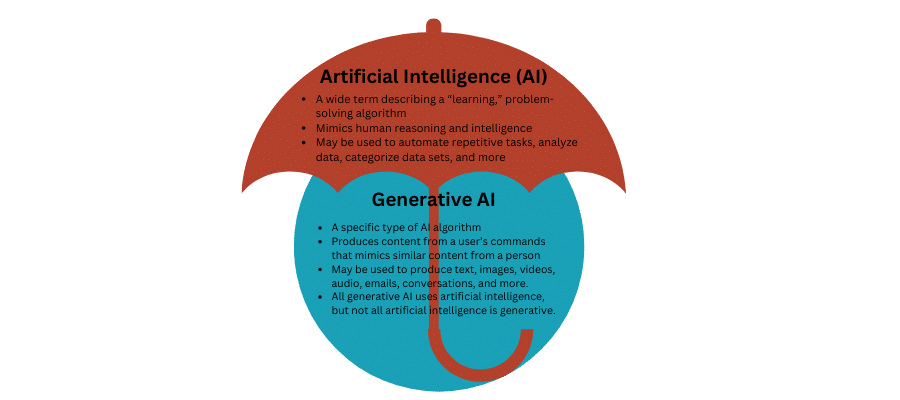
Artificial intelligence is a broad term, while generative artificial intelligence is a more specific type of AI.
There are now hundreds of thousands of apps and programs using AI. They accomplish all sorts of tasks and are used for a wide variety of applications. For the purposes of this blog post, we’re talking about generative AI programs that produce answers when prompted. Some of the most well-known platforms in the US are OpenAI’s ChatGPT, Google’s Gemini, and Anthropic’s Claude.
In some ways, search engines and AI engines generate their results in similar ways, but AI’s methods are more complicated and nuanced. In simple terms, search engines like Google or Bing use two components to generate results. They use “crawlers” that move through the web, assessing websites, webpages, and content. They also use algorithms that determine how to organize these pages when a user enters a relevant query. SEO is the process of creating content and websites that work with these algorithms in order to improve a website’s visibility across search engines.
AI apps work in similar ways. In a way, AI apps also draw on information from the web and a program that tells them how to produce results. But these apps don’t simply produce a list of results. They produce conversational answers that you can interact with and ask follow-up questions about.
Some of these terms can become confusing. Let’s clarify a few key terms before we continue.
- Artificial intelligence (AI): Computer systems using huge amounts of data and patterns to perform complex tasks involving language, images, numbers, predictions, operations, and more.
- Training data: The large collection of content an AI model learns from during training, such as web pages, books, articles, code, and other material, plus human-written examples and ratings used to refine the model’s behavior.
- AI model: The trained AI system that produces answers. It consists of architecture and weights that hold its knowledge and abilities. Models have version names, such as GPT-6 or Claude Opus 5.5.
- AI lab: An organization that researches, trains, and designs AI models, such as OpenAI, Anthropic, Google DeepMind, or DeepSeek. This takes huge amounts of computing power and resources, so there aren’t many of these labs worldwide.
- AI app: The customer-facing product using an AI model, such as ChatGPT, the Claude app, or Gemini.
- Third-party AI app: An app built by an outside company using another lab’s model, either rented through the lab’s API or downloaded directly. Often, the distinction between first-party AI apps and third-party apps is not immediately clear.
How Do AI Apps Produce Answers?
Like search engines, AI companies send automated bots to crawl the public web. They also use a vast data set provided online, such as Common Crawl, a large free archive of the public web, as well as books, code, other content, and examples and ratings written by human trainers. This body of data inputs is sometimes called the training corpus. There is some controversy around this that we will discuss more in the controversies section.
This vast amount of information then receives feedback and editing by humans to help refine the information and show the AI app what to do with it. These are called “weights” or parameters. These weights then help the model know how to create a response to a query. This is similar to the algorithm search engines use to organize a response, but AI’s workings are more complex.
The AI app additionally factors in a user’s previous queries and information they provide. It also might conduct internet searches to find information that wasn’t a part of its original training data. Finally, an AI app can integrate with other programs if directed, where it can then gather additional information and additional, specialized training can be provided for a particular goal.
What Does AI Mean For Your Business?
So, what does AI mean for your business? Consumers are increasingly turning to AI apps to get their questions answered, to do research, and for many other things.
Data shows that AI use is growing:
- According to Pew Research Center, about half of U.S. adults now use AI chatbots, up from a third in 2024.
- Google has reported seeing over 1 billion regular users for their AI app Gemini in 2026.
- ChatGPT has also reported over 1 billion regular users in 2026.
- L.E.K. Consulting surveyed 2,650 consumers and found 30% used AI to inform a purchase decision.
- In a study by Semrush, 77% of respondents said they used both AI and search engines together.
At least currently, AI apps are not replacing search. However, AI apps are increasingly informing the purchase process. Additionally, the distinction can be murky: most search engines have now integrated AI into their search features to provide answers right away, so users never have to click on a search result at all. This has resulted in many websites seeing falling traffic as use of these features and apps has grown.
All of this means that it’s valuable for your business to appear in AI results. It’s likely that these trends will continue, and working to optimize your website for AI will help you gain competitive advantages as more consumers adopt this technology.
But how do you know if your business is appearing in AI answers? Several tools are now available that can (or claim they can) measure and quantify your AI visibility or level of Generative Engine Optimization (GEO). However, like search engines, most of these models do not openly explain the weights or parameters on which their model functions. So how is any platform gathering this data?
How AI Visibility Tools Measure Your Brand
Many of the same platforms that have traditionally measured SEO and keyword rankings have now also created tools to measure GEO. This includes platforms like Ahrefs, Semrush, Hubspot, and Moz, among others. Some of the data provided can be helpful, but it’s important to understand what it actually represents.
Sampling and Scoring
No AI visibility tool can see what real people asked ChatGPT or what it told them. AI companies don’t share that data. Instead, every tool works by sampling. The tool builds a list of questions or prompts (or allows users to build them), runs the prompts on each AI app, scans the results for your brand, business name, or website, and then provides a score.
UI Scraping vs API Calls
This scanning process works in roughly two different ways. Some use API calls, which relies on a direct programmed connection to an AI app and scans information that way. Others use programmed bots that create queries in the AI app itself, and “scrapes” the information. There are different schools of thought on whether using an API connection is better, or using UI scraping is better. It’s currently unclear which provides a better dataset.
AI Visibility Tool Caveats: What Tools Can’t Tell You
There are several important caveats to this data. It’s important to understand that users communicate with AI apps in a more conversational and nuanced way than search engines. This means it’s impossible to predict every possible conversation and response. This puts notable limitations on AI visibility data.
Estimations, Not Exact Data
AI visibility tools essentially give you an overview of how your business appears. It can’t, for example, tell you exactly how often you appear or exactly what queries customers are using to find you. These tools give you an estimate based on a particular data set.
Some tools collect data on millions of terms and can provide insights that way. For instance, it might collect data on two related terms and it can tell you whether you appear for one and not the other. If your business is very niche, platforms probably won’t collect data on terms or queries related to your business, so this data won’t be as relevant for you. It may be better to enter terms or queries yourself, and make comparisons that way.
Rankings Aren’t Reliable
While a search engine will provide pretty much the same results if you enter the same query over and over, AI apps won’t. Repeated testing suggests that AI apps do not return the same responses, even when the same app is asked the same question multiple times. When it comes to brand recommendations, for example, AI apps will provide different brands, different rankings, and different wording overall. However, across multiple related queries and time, there’s more consistency in brand mentions, though not in ranking. This means that mentions over time is a reliable metric, but rankings generally aren’t.
Watch Trends Over Time
Since queries and answers change over time, it’s important to watch how your brand appears over time. You’ll get more accurate and actionable data the longer you watch. If, for example, you notice your brand appears less often over two weeks, this could be a result of multiple factors you can’t control. If you notice your brand appears less often six months, this is a more reliable sign that something has changed with your own content or website, or that your competitors have overtaken you.
How to Spot a Reliable GEO Tool
There are already quite a few tools claiming to offer data about your AI visibility, GEO score, or similar metrics. Some of them may be reliable, while others aren’t. As AI becomes a bigger part of doing business, more of these tools will appear. So how can you determine which ones will give you accurate measurements, and which are just making claims?
The following questions can help you determine how the tool works, how accurate the information is, and what information it actually provides:
- How are the tracked prompts chosen, and can we add our own?
- Do you collect answers through APIs or the real user interface?
- How many times is each prompt run, and how often?
- Which AI platforms and regions do you cover?
- How is your AI visibility (or GEO, AIO, AEO) score calculated?
If a vendor can’t answer these clearly, treat its scores with caution.
How Can You Improve Your AI Visibility?
We’ll discuss this in more detail in a later blog post, but knowing how to improve your AI visibility score can help you better understand it. There are essentially two routes to do this.
Route 1: Be part of what AI learns
This is the long game. AI models form their sense of who the leading businesses are from how often, how consistently, and how credibly those businesses are discussed across the web.
- Keep your business name, services, and key facts consistent everywhere they appear.
- Earn mentions in industry publications, local news, and trade associations.
- Encourage reviews on the platforms your customers use.
- Take part in the online communities and forums where your industry is discussed.
Results here build slowly, because they depend on future training cycles.
Route 2: Be findable when AI searches
AI apps may also conduct a fresh internet search in response to a user’s query. This is where your website does the work, and where good SEO still pays off.
- Check your robots.txt file. Make sure you aren’t blocking AI search bots such as OAI-SearchBot, Claude-SearchBot, or Google’s crawlers. You can block training bots and still allow search bots if that’s your preference.
- Rank well in traditional search. When AI searches the web, it reads the top results first.
- Write clear, direct answers. Pages that answer specific customer questions in plain language are easier for AI to summarize and cite.
- Make pages easy to read for machines. Fast, well-structured pages with clear headings and content that loads without heavy scripts are easier for bots to process.
Controversy Around AI Apps
When discussing Artificial Intelligence, it’s important to also discuss the effects, limitations, and other controversies surrounding the technology. Like many powerful technologies, there are important functional, legal, ethical, and environmental concerns surrounding it. And, also like many powerful technologies, more informed use can help maximize benefits and minimize risks.
Note that our list here is not exhaustive, and is only a brief overview of a few of the controversies around AI apps and technology.
Copyrights, Copying, and Imitation
Some aspects of AI training have caused controversy regarding copyrights and ownership. These models were trained using vast amounts of content across the internet produced by humans across time, all over the world. Though the tools don’t directly reproduce anyone’s content verbatim, these tools need this human content to exist. Many authors, publishers, websites and others have filed suits against AI businesses and labs, alleging that their work has been used without their consent. Since this content is or can be used to then create duplicative, imitative, or replacement work that causes monetary or reputational harm to the artist, publisher, or others, these lawsuits may be particularly important in protecting creative work of humans moving forward.
Hallucinations
AI can be confidently wrong. When the model answers from memory without searching, it’s reconstructing information from patterns, not checking a source. Most of the time that works well. Sometimes it produces outdated details, mixes up similar information, or states something that isn’t true. These are called hallucinations. These hallucinations can then cause people to believe false information, or can cause more significant problems if AI is applied to systems like healthcare, data management, infrastructure management, or other critical systems.
Abusive Content
AI is a content generation tool, and it can be used to generate almost any content. This includes images that closely resemble real people or situations. Using AI tools, some users have generated images of real people that are pornographic or otherwise abusive. Elon Musk’s AI tool Grok, in particular, has been implicated in numerous lawsuits involving abusive material, particularly that which targets minors, and has openly fought the use of safeguards that could protect them.
Water Use, Noise, Energy Use
AI apps require enormous amounts of processing power, which requires a lot of energy and computational components. These large groups of computers, often called data centers, get hot as they operate, which requires cooling, often through freshwater use. Though data centers aren’t only required for AI apps, these apps require more resources than other data centers, since they provide more sophisticated results. This has led to worldwide public debates about the usage of space, noise complaints, water usage for cooling, energy usage, wildlife damage, and more.
Misinformation and Disinformation
Misinformation (unknowingly spreading false information) and disinformation (knowingly spreading false information) have become increasingly difficult problems as the internet has expanded. Besides causing people to simply believe falsehoods, misinformation has unfairly influenced elections, weakened democracies worldwide, increased misogynistic and racist violence, and even contributed to genocide, among myriad other problems. AI apps make it easier than ever to generate and spread false information, and harder to stop. Similarly, an appropriate suspicion about data or images can make it harder to believe real information, such as documentation of crimes, important new discoveries or innovations, world events, and more.
The Bottom Line: Careful Use Matters
As previously stated, this is only a small overview of the risks of these powerful tools. While there are also many opportunities and valuable benefits possible, it’s important to keep the risks in mind so we can fully, effectively, safely harness these benefits. Most of us want to use AI to solve problems and create better, easier lives. Without an understanding of the risks and hazards, it’s possible for this technology to create more problems than it solves.
Ultimately, it’s important to remember that AI is a tool—it is not a person, a Terminator, an existential threat or utopian vision. We will all decide how that tool is used. The systematic and institutional use of AI matters, as does our own personal and professional use. In addition, the narratives we tell, believe, and participate in will shape how AI is legislated, used, and evolves on a larger scale.
Previously, safeguards around technology like social media and internet privacy have fallen short, partially because of the narratives surrounding it. But, it’s possible for the safeguards around AI to work better, if we pay attention.
AI Visibility for Your Business
AI visibility is measurable, but only approximately. The tools are sampling a moving target, so their scores work best as a directional signal. Want to know how your business shows up in AI answers? Web Ascender can help you review your AI visibility, check that your site is accessible to the right bots, and build a strategy that works for both traditional search and AI. Contact our team to get started.
Frequently asked questions
Do AI assistants like ChatGPT store copies of my website?
Not in the way a search engine does. Training turns web content into patterns inside the model rather than saving the pages. When an AI searches the web live, it reads your current pages at that moment.
Can I see exactly what ChatGPT tells people about my business?
No. AI companies don’t publish that data. AI visibility tools estimate it by asking sample questions and recording the answers.
Why does my AI visibility score keep changing?
AI answers vary every time, even for the same question. Some movement is normal. Look for trends over several weeks or months.
Does blocking AI bots hurt my visibility?
It depends on which bot. Blocking training bots like GPTBot or ClaudeBot only affects future training. Blocking search bots like OAI-SearchBot can remove you from that assistant’s search answers.
Is SEO still worth investing in?
Yes. When AI assistants search the web, they rely on search indexes and read top-ranking pages first. Strong SEO supports both traditional search and AI visibility.