


Throughout 2024, many users have noticed a decline in the quality of search results when they enter a Google search. This is likely due to a surge of low-quality content produced by artificial intelligence programs and content farms. Google has reacted to this content with a recent update. The update has considerably reorganized search results, reducing the appearance of unoriginal or low-quality content, and completely de-indexing hundreds of sites. Let’s take a look at what this may mean for your website. Note: this post has been updated in June, 2024 to further discuss the controversy surrounding this update.
Google’s Latest Core Update: Eliminating 45% of Spam
Google frequently updates the algorithm that determines how the search engine categorizes and shows results. Google’s March 2024 core update was specifically focused on combating duplicative, unoriginal, or unhelpful content appearing in the search engine results. This update presents serious changes to how the Google search engine indexes web content and shows it to its users. Some SEO experts speculate that this update is as significant as Panda or Penguin updates, which dramatically changed how the search engine dealt with spam content, content farms, and “black hat” SEO tactics.
According to Google, “This update involves refining some of our core ranking systems to help us better understand if webpages are unhelpful, have a poor user experience or feel like they were created for search engines instead of people.” The update began in March, and completed in mid-April. After this development, Google claims, “You’ll now see 45% less low-quality, unoriginal content in search results.”
With the goal of ostensibly improving search results for users, Google took several actions to remove low-quality content that met specific parameters. This included manually de-indexing over 800 websites completely, and algorithmically penalizing pages from others. In this blog post, we’ll take a look at these measures in more detail, and discuss how your site might be affected by these changes.
Controversy: Is It Spam? Are Results Getting Better?
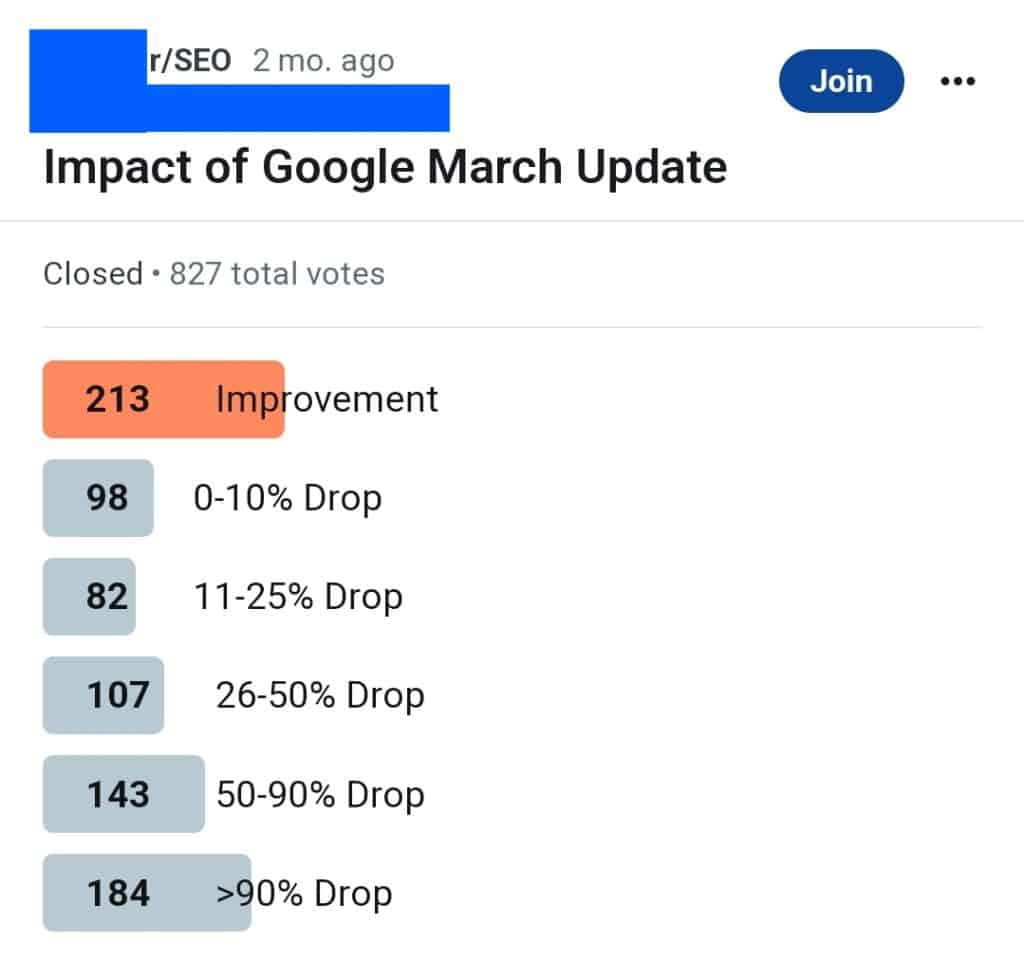
The effects of the Google core update vary widely. Many have seen improvements to their site, though many others have seen large traffic losses.
Though many have agreed that the core update has mainly targeted spam sites, others contend that the update has unfairly targeted small, niche, or underrepresented sites in favor of larger media conglomerates, which already represent an outsize number of top results on Google. Some have claimed traffic on their small or new sites all but disappeared in a matter of days, for no discernible reason. We’ll discuss some of these concerns later in the blog post.
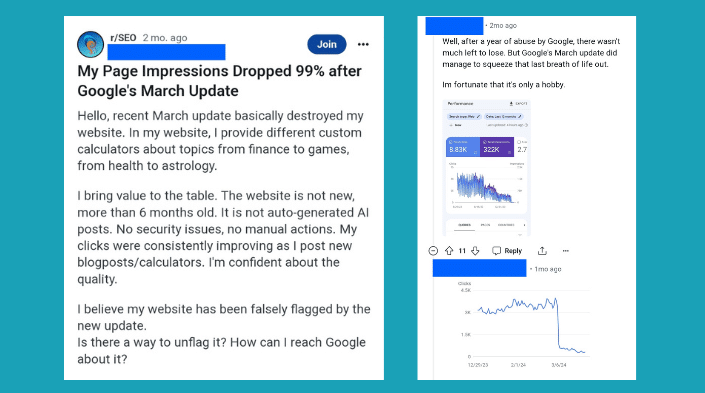
Some web authors state that the March Google update unfairly damaged their site, and they didn’t produce spam.
June Update: Other, larger, and more established websites saw similar hits to their traffic. The BBC reported on the algorithm change, showing established sites such as Thrillist, GQ, and Oprah Daily, among dozens of others, losing 20 to 80% of their traffic in just a few months. At the same time, Q&A sites like Reddit, which just became a publicly traded company as of March, 2024, saw an unprecedented 126% increase in traffic. The combination of the core update with the implementation of Generative Artificial Intelligence has caused some sites’ traffic to plummet in a matter of weeks or even days.
June Update: On top of the painful hit to many websites and publishers, the controversy contains another layer; have these updates actually made Google search results better? Inundated by unhelpful and, at times, downright ridiculous AI-generated responses, and outdated results from the same giant publishers, most users say no. Some have discussed the possibility that these problems are symptoms of a larger, inevitable decline within Google—and other large platforms—due to a lack of competition, lack of regulation, and the impossibility of a monopoly to capture any further market share.
Google’s New Rules on Spam
Specifically, what types of low-quality content is Google eliminating? What is against the rules? Google has long used spam policies to prevent websites from abusing SEO strategies, luring searchers into hacked sites, or circumventing Google’s algorithm. The new spam rules build on the existing rules to reduce the appearance of low-quality content when a user makes a search.
Scaled Content Abuse: Content Mills Are Out
Google’s new policies expressly forbid the use of “scaled content.” This refers to content that is generated quickly, with little research or new information. This might be produced by ghostwriters or freelancers, or generative AI programs, like ChatGPT.
Some have speculated how Google’s algorithm might accurately identify whether or not a website uses content that is produced by ghostwriters, freelancers, or AI programs. Even many popular AI-detection tools struggle to sort a real person’s writing from computer-generated writing. Moreover, it can be difficult at times to determine whether content was written by a freelancer with little knowledge on the subject, or an expert or collaborator who is trying to simplify the content for a general audience.
Obviously, Google could not specifically explain how it identifies scaled content, or black-hat SEO strategists might start to work around the rules. However, there are a few signs that likely signal to Google’s algorithm that scaled content is being used, including the following:
- Posting too much: Some websites that were removed by Google were posting hundreds or thousands of new pages each day. Posting too often may be a sign that your content isn’t well-researched or composed by a real person.
- Unoriginal: Generative AI tools use existing knowledge on the web to formulate new content. This means AI content isn’t original and doesn’t present new ideas. The same is true for many content mills or content farms using poorly-paid freelancers. Putting original ideas and new information into your content can help it stand out for the better.
- Duplicative: Some content may use the same wording or organization from other content already existing on the web. This is a red flag to search engines that the content is plagiarized, and the site isn’t high-quality.
Expired Domain Abuse: Don’t Repurpose Websites
Another strategy Google is cracking down on is “expired domain abuse.” Expired domain abuse refers to buying a different domain, and repurposing the website with unrelated content, in order to use the domain’s existing reputation to amplify the SEO quality of the new content. Often, these types of strategies are obvious, since the new content is clearly unrelated to the old content or the original site itself. However, this may have implications for users who are purchasing a new web property or shifting their domain. Let’s take a look at a few examples.
- Merging domains: Maybe you’ve previously operated two or three different websites for different aspects of your company, and you now want to merge them into one domain. This significant reorganization may be a red flag to Google’s new core update. Consider how much the content on one domain is changing, and whether or not the new content makes sense with the position of the original domain.
- Purchasing a competitor: If your company is in the position to purchase a competing or partner company and grow your business, you’re likely to also purchase their website and domain name. Maybe they had a long-standing domain that confers a good-quality SEO score, but they didn’t produce a lot of content. Significantly reorganizing this site or adding a lot of content to it may set off the expired domain abuse portion of the new Google update.
- Buying a domain: You may be in a position to purchase a domain that consistently gets more traffic or performs better than your site. This can be a good strategy to grow your audience and expand your position, however you should consider carefully the content and purpose of the site you’re purchasing. If it’s significantly different than yours, taking over the domain with your content might end in de-indexing.
Site Reputation Abuse: Use Third-Party Content with Care
Site reputation abuse is similar to the previously mentioned expired domain abuse, since it leverages the reputation of one site to benefit another. However, site reputation abuse involves two parties with independent domains that both still function. Site reputation abuse refers to publishing content from another party on your website in order to use your site’s high quality or reputation to elevate the third party’s content.
Often, websites will host another party’s content because they are being paid or there is another type of business relationship occurring. For example, a site may work hard to generate valuable, high-ranking pages for specific topics, only to then publish a series of other pages from dissimilar sites which pay for the privilege.
Not all third-party content is considered spam. Google outlines several examples of site reputation abuse and valid third-party content in its spam policies. Some of these examples are quite clear, while others are a bit murky. For example, “Coupons that are listed with close involvement of the hosting site” are considered valid, but “A news site hosting coupons provided by a third-party with little to no oversight or involvement from the hosting site” is not. It’s unclear how Google’s algorithm determines how involved (or not) the hosting site is.
Some aspects of site reputation abuse are clear, and can be easily avoided. Integrating third-party content into your site can still be an effective way to grow your audience and provide high-quality content, or even take advantage of business relationships, but it’s important to keep a few rules in mind. These rules of thumb should help you avoid running afoul of Google’s core update regarding site reputation abuse.
- Relevance: When hosting another party’s content, it should be related to your regular content or the purpose of your site. Google’s spam advisories repeatedly mention irrelevance as a red flag, such as “A medical site hosting a third-party page about ‘best casinos’” or “An educational site hosting a page about reviews of payday loans.”
- Review: You or your staff should review the content you are hosting, and should have some editorial power or involvement in it. Google’s spam policies also mention a lack of review or involvement by the host as a red flag.
- Relationship: Be transparent about your relationship with the third party. If the third party pays for a link or ad, say so, and use the proper tags for the promotional link. If you are hosting a third party’s content because it is informative and relevant to your site, mention that as well.
Existing Spam and Content Policies
The previously mentioned rules are expansions to Google’s existing spam policies due to the core update to the algorithm. Scaled content abuse, expired domain abuse, and site reputation abuse are certainly not the only practices that can get your site penalized by or banned from Google.
Google’s existing spam policies cover a range of practices, from hosting malware to using deceptive tactics like cloaking, doorways, keyword stuffing, link spam, and more. There are also general content policies which forbid the use of some content that is hurtful, exploitative, violent, etc.
Google’s March 2024 core update cracking down on low-quality content shows that the search engine is serious about eliminating sites that violate their spam policies. If you’re not sure whether or not your strategies are above-board, now is a good time to review Google’s spam policies, and make changes where needed. It might also be helpful to review Google’s SEO recommendations, and what constitutes the content it prioritizes, which it describes as “helpful, reliable, people-first content.”
Will Your Site Be Affected?
In some cases, these low-quality content rules may seem obvious and necessary. As we search, most of us have probably encountered sites that provide little value, content that is poorly written, or pages that are clearly designed to manipulate search rankings to make money. However, many SEO experts have claimed that their sites have been unnecessarily targeted by the tighter content restrictions resulting from the core update.
Some claim that the following attributes may cause a site to be de-indexed unfairly. Though it seems these attributes are not being intentionally targeted by the core update and expanded spam policies, they may be collateral damage.
- New websites: Some with newly public websites and new domains claim their sites were deindexed unfairly, perhaps because these new domains inherently have a low quality or trustworthiness score.
- Purchased domains: Some who have purchased domains and started producing content for them claim they were deindexed under the expired domain abuse rule, when they were in fact producing relevant content. Since it is easy to programmatically determine when a domain’s ownership has shifted and when an expired domain is active again, this rule might be particularly strict, with less subjectivity.
- Niche topics: Sites or pages targeted to very narrow searches may be deemed manipulative by the algorithm, even when they’re not intended as such.
- Thin content: Pages that are not well described or offer little information (around 300 to 500 words, by some estimates), may be seen as unhelpful and low-quality, and therefore deindexed.
- Over-reliance on AI: It’s fairly clear that the usually simple, repetitive content from AI programs has made search results worse, which is a big problem for Google. Though a bit of computer-aided assistance is surely acceptable, sites relying too much on AI are likely to face penalties, either now or soon.
June Update: As previously mentioned, many sites have been affected by the core update, including many long-standing websites producing engaging, informative, and helpful content. Though some practices are more likely to result in traffic penalties, for many websites, it’s unclear how this update will affect them.
How To Tell If Your Site is Penalized or De-Indexed

If you think your site was de-indexed from Google, you can check by searching your site after “site:”. Ours appears, but if yours doesn’t, you might be in trouble.
How do you know if your site was penalized as a result of the March 2024 core update? There are a few ways you can tell.
- Search your site: If your site was deindexed, it means it will no longer show up when you make a relevant search on Google. So, the first and easiest way to see if your site was deindexed is to simply search for the name of your business or organization. If it doesn’t show up, try the more specific search “site:yourdomain.com” and put your URL after “site:”. If it still doesn’t appear, it’s likely your site was deindexed. If your site shows up, it means at least some of your pages still appear, though it’s still possible that others were deindexed or penalized.
- Traffic slump: The next way to tell if your site was affected by the spam policy changes is to check out your site’s traffic using Google Analytics or a similar program. If you notice a significant loss in traffic that started around March or April in 2024, and traffic did not recover, some of your site may have been deindexed or penalized.
- Manual actions report: If you think your site might have been affected, check out your manual actions report. This report is provided by Google, and shows whether or not your site or pages have been deindexed, and shows why this might have occurred.
- Additional reports: If you don’t see a manual action, other incidents might have occurred that affected your traffic or indexing. Additional reports, such as your core web vitals report or page indexing report might give you more information explaining what happened.
Could This Be Good For Your Site?
If you consistently publish high-quality content that offers new and helpful information, this crack-down on low-quality content and spam might be good for your site. Maybe you’ve noticed a surge in content in your industry that is AI-generated, or you consistently see simple, thin, or unhelpful content ranking better than yours. In this case, you might notice some improvements in traffic in the coming months.

Some were negatively affected by the 2024 core update, but other sites, like this one, have seen their traffic rise.
How to Avoid Future Content Purges
This core update indicates that Google is taking a harder stance against content that it deems to be unhelpful, irrelevant, or manipulative of its algorithm. If your site hasn’t been penalized, but you’re worried that your content might not make the cut in the future, there are a few things you can do.
- Originality and expertise: Prioritize creating content that has some original elements, and incorporates some expertise. While you can still work with copywriters, freelancers, or generative AI to flesh out your ideas, it’s important to review this content and incorporate some information from an industry expert.
- Avoid manipulative SEO: Use SEO strategies to define what your audience is looking for and hone in on what your content is about. Tactics to outsmart the algorithm aren’t likely to be fruitful at this point.
- Relevant and helpful: Focus on content that is relevant to your industry or organization, and helpful for your audience.
It’s likely that we’ll continue to see expansions on Google’s March 2024 core update that cut away more spam and, hopefully, improve search results for all users. If you focus on content that is helpful, original, and clear, these updates are likely to be helpful for you. If you’d like help with content curation, digital marketing, SEO, and similar services, we can help. Get in touch with us today to discuss a plan.