


Many websites have recently taken heavy hits to their organic traffic. Some of the strategies that used to work are no longer paying off, and simply creating high-quality content isn’t getting the notice that it used to. Let’s take a look at a few SEO strategies to bring traffic back after a slump.
6 SEO Strategies to Bring Traffic Back
Google’s core update in the spring of 2024 brought heavy traffic hits to a wide variety of websites. Some of these were spam sites that were eliminated from results in order to improve search results for users, while others delivered high-quality content and were penalized for reasons that are unclear. Though Google claims that it prioritizes websites that produce content that is “helpful, reliable, people-first content,” this does not seem to be effective by itself for many websites. These strategies can help you curate your content in ways that target specific queries in order to build up traffic.
1. Focus on Long-Tail Keywords
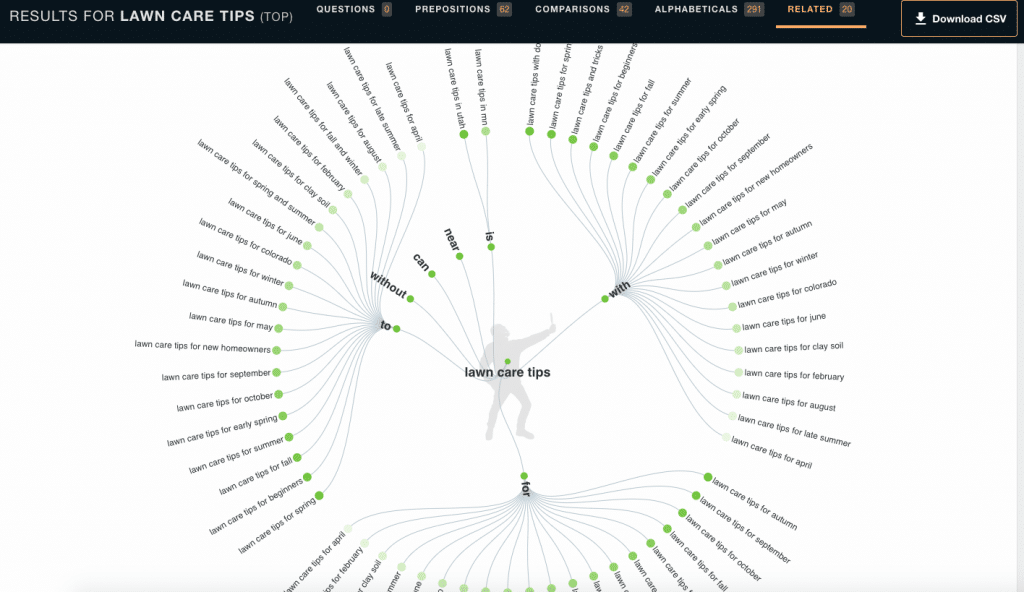
Answerthepublic.com provides a range of topics from any category.
In a study of 250,000 keyphrases, 16 companies (which own 588 brands) occupied over 86% of the top spots in the search results on Google. While this is only a subset of the millions of different keyphrases a user might enter, this distribution is likely to be accurate across most of the valuable, broad keywords, especially those that indicate a strong purchase intent.
Big brands simply have more resources to occupy top search results spots on competitive keywords. These companies can interlink between their different web properties, giving their pages more backlink authority, they use AI programs and professional writers, photographers, and videographers to build content quickly, they can optimize their website speed, and more. This means that trying to grab top spots from broad keywords is probably not an effective strategy.
Long-tail keywords that are more specific and highly relevant to your website are likely to be more fruitful. These long-tail keywords will have less traffic, but less competition. The following are a few examples of long-tail keywords. Let’s explore these using the perspective of a local landscaping company
- Answering questions: Answering a specific question with an informative blog post or landing page can help boost traffic and attract users who are invested in your business or industry. This is also a good way to engage with your community, which we’ll cover in more detail later in the post. (Ex. “How do I know if my lawn is infested with grubs?”)
- Specific location: Exploring problems that are specific to your location can help you engage a local audience. This is particularly helpful for brick and mortar stores, or those focused on a specific area. (Ex. “The best native flowers for gardens in Michigan”)
- Specific problem: Addressing a specific problem can help bring in potential customers that are struggling with an issue that you have a solution to. This is a good place to show off your unique knowledge and expertise; provide solutions that others might not know. (Ex. “The best grasses for dry, sun-soaked lawns.”)
Finding Long-Tail Keywords
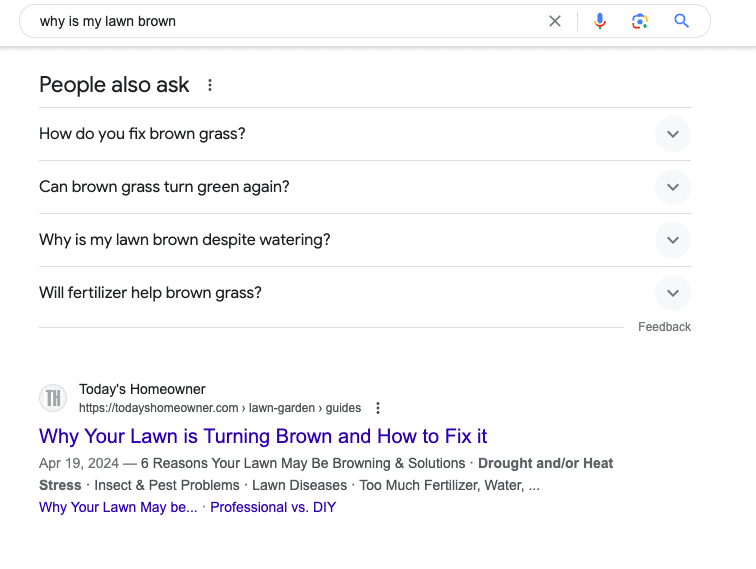
The “People Also Ask” section of Google search results can provide some good long-tail keywords.
Because they are more specific, long-tail keywords often will not appear in keyword suggesting platforms like Google Keyword Planner or SEMrush. However, it’s also important to focus your content on long-tail keywords that your audience is actually interested in. Here are a few strategies to hone in on specific keyphrases that are likely to be fruitful:
- “People Also Ask:” The “People Also Ask” section of a Google search results page can provide more specific questions about a broad topic.
- Consult with customers: Your customers may have specific questions that you can answer. Make a note of these questions as they arise, and see if you can provide some answers.
- Monitor online communities: Traffic to sites like Reddit and Quora have surged. Monitor relevant pages within these communities, and see what questions users ask. This can also help you gather traffic and links from these sites, which we’ll discuss more in the next section.
- Answer the Public: This site gives you a network of queries related to a broad keyword, including “who, what, when, where, why” queries.
2. Community Building
Reddit’s traffic tripled after Google’s core update. Quora, a similar forum site, saw its traffic more than triple. This may be a response to users repeatedly adding “Reddit” to their searches in an effort to find real human responses as opposed to AI-generated blog posts or repetitive articles.
This is also related to Google’s $60 million annual access to Reddit’s content in order to train its AI model. In a press release, Google stated, “This partnership will facilitate more content-forward displays of Reddit information that will make our products more helpful for our users…” This is also related to Reddit’s public offering in March, 2024. Immediately following the eight months of meteoric growth thanks to Google’s partnership, Reddit, which has not been profitable in 20 years, announced it was going public with a $6.5 billion valuation.
Regardless of the machinations behind Reddit’s sudden growth, this platform can provide a good strategy to bring traffic back to websites that have taken a hit. Users utilize Reddit, Quora, StackExchange and similar forum sites in order to get answers from real humans. Thousands of different “subReddits” and similar sub-forums on these sites are home to communities of people looking for and providing answers and expertise in particular industries. This can be a good way to provide a link to your content. However, it’s important to keep a few things in mind.
- Read the community’s guidelines carefully and follow them. Note whether or not they allow the posting of links. If not, this might not be a helpful forum for building traffic.
- Answer the user’s questions, don’t just provide a link. You might answer the user’s question in a general way, and drop a link to your page for the user to get more details.
- Be courteous and polite. Don’t take sarcastic or off-color comments personally, and don’t reply to them.
- Engage with the community. Set aside some time to regularly review the forum and participate, otherwise you run the risk of being banned for self-promotion.
3. Partner Link-Building
To prevent manipulation, search engines do not explicitly explain how their algorithms work. But, we know there are likely about 700 different factors that Google and other search engines use to rank content. We also know that links are an important part of these ranking factors. When other reputable sites link to yours, it’s like a vote of confidence showing that the content of your site is reliable, accurate, and helpful. If your pages or website don’t have strong backlinks, it’s difficult to compete with pages that do.
Building backlinks is an important SEO strategy to bring traffic back. One way to do this is to trade links with your colleagues and partners. There are several ways to go about this.
- Link trading: Speak with a relevant person in your network and ask them about trading links; they include a link to your site on one or a few of their pages, and you include links to theirs. Make sure the links are relevant, and the content you are each linking to is high-quality.
- Partner pages: Consider creating a page that includes a list of industry partners that you work with, and linking to their sites. In exchange, ask them to include links to your site as well. Make sure this page includes more than just links, but also includes a profile of your colleagues, with images and important information.
- Guest posting: Work with other content creators in your industry and feature their content on your site. In return, ask them to do the same. This can be a great way to build links, keep your content fresh, and trade experience and expertise.
Where possible, focus on pages that are important to your site and that already perform well, or used to perform well. It can be tempting to use this strategy on the pages that aren’t performing well in an effort to improve them, but this strategy is likely to work better on pages that already have other positive SEO aspects.
4. Pillar Pages
Longer pages with more detailed information tend to perform better than thin, cursory pages. Pages that cover a topic in-depth are sometimes called pillar pages. These pages can serve as informational hubs, as well as gathering points for internal and external links. You can add to them and update them continuously, so they should cover a topic that is evergreen. Pillar pages work best when they’re bolstered by other content, often blog posts, that link to them.
Your pillar pages might simply provide information and answer visitors’ questions. However, they might also be an un-gated version of a guide or ebook. Give your readers the opportunity to download the information in a PDF or another format if they choose, but an ready, readable version on your website will help to improve dwell times, which will help to improve SEO and get more traffic. Include CTAs on your website as well, such as invitations to contact you, get a quote, schedule a consultation, and so on.
5. Location-Specific Pages
As previously mentioned, pages that are more honed-in on specific topics are likely to perform better than pages with a general focus. Location-specific pages work in similar ways.
Many location-focused landing pages don’t contain a lot of content or provide much information other than an address. Use a few SEO strategies to improve these pages and make them more competitive, including the following:
- Build up content: Add more text, as well as images and video, where possible, to your page. Make this content relevant to your location. It might include a tour of your local store, a profile of local goods you carry, location-specific problems your business solves, or something similar.
- Provide value: The content on your location-specific page shouldn’t be filler. Use your content to answer questions, provide information, and build real value on the page.
- Use a keyword focus: Use a keyword or keyphrase strategically, about three or four times, on the page. This might include the location in combination with lucrative or important keywords for your industry. For example, a landscaping company might use the keyphrase “Lansing, Michigan landscaping and lawn management” and similar keyphrases.
6. Revisit Popular Pages
The pages on your site that receive the most organic traffic will inevitably lose their appeal over time. As the information on these pages gets older, it will become less relevant and it will be usurped by more recent pages. The links may also break as sites rearrange, pictures or images might not display properly, and important code might not work properly. Revisiting and updating these pages can help to bring traffic back and regain valuable top spots on search engine results pages.
Here are a few tips to update your high-performing pages:
- Update content: Add text, images, or videos where applicable. Update any statistics or information that has become outdated. Add new information.
- Update publish date: Show the publish date of your post, and make sure it’s updated.
- Update links: Check the backlink profile on the page, and check for opportunities to build more external links. Look through your other pages and link your pages internally where possible.
- Check page speed and performance: Make sure your page is loading quickly, your pictures and videos are displaying properly, and your links are working.
Thinking carefully about your SEO strategy and making adaptations can help you build up your organic traffic again. Work with others in your industry, aim for long-tail keywords, build links thoughtfully, and continue to produce informative, helpful content. If you’re struggling to build traffic and leads on your site, contact us today. We can help you formulate a digital marketing strategy that suits your business and your customers.