


Every website has to be hosted somewhere. For many businesses, affordable web hosting can help to keep costs down and allow you to focus on more important matters. However, there are some hidden costs of cheap web hosting that businesses and individuals should know. Let’s take a closer look at what web hosting is, how it works, and the real costs of cheap web hosting.
What is Web Hosting?
First, what is web hosting? Web hosting is essentially a service that provides the physical space and resources, like storage, bandwidth, and processing power, needed to make your website accessible on the internet. When someone types in your domain (like webascender.com), their browser connects to your web host’s server, which delivers the website files to their screen.
It can be helpful to think about it like this:
- – Your domain name is your street address.
- – Your web hosting service is the actual building.
- – Your website (like the design, images, text etc.) is everything inside the building.
Different Types of Web Hosting
 There are different types of web hosting, and they operate in different ways and provide different capabilities. Understanding the basics of how these different systems work will help you understand why some of these options have hidden costs built into them.
These systems are the result of decades of development, and have become quite complex. Many hosting services offer a variety or even a combination of these services. For our purposes, it’s only necessary to understand the basics of each, so we’ve simplified these somewhat.
Shared Hosting
Some web hosting companies own their own servers, which are essentially a series of large computers, usually in a warehouse. They will often host multiple different websites across these servers. In many cases, your website shares actual server space and computing power with other sites. Or, in the case of dedicated web hosting, one business or organization will have a server completely to themselves.
Shared hosting is the most common option for individuals and small businesses. This option is also generally the cheapest. However, this option also has some hidden costs that we’ll discuss later in the blog post.
- – You share server space with other websites
- – Common for small businesses and individual websites or blogs
- – Web host services like Bluehost and GoDaddy use this model.
Virtual Private Server Hosting
Virtual private server (VPS) hosting works similarly, but there are some key differences. With VPS web hosting, the web hosting service owns a physical server, but it’s split into virtual compartments. Each website on the VPS host shares space with other websites, but in a more abstract way. This arrangement generally gives users more dedicated resources, control, and security, but it’s more expensive.
- – You share virtual server space with other websites
- – A good option for larger businesses and organizations
- – Examples of VPS web hosting providers include InMotion Hosting and Liquid Web
Cloud Hosting
Cloud hosting is also similar, but more advanced. Cloud hosting connects an enormous network of servers and many websites all share the power these servers provide, but none are hosted on any individual server—they all share space collectively in the cloud. This is the most advanced and generally the most expensive option. It also gives websites maximum performance, minimizes downtime, and allows them to scale faster.
- – You share virtual server space with other websites across a huge network of interconnected servers
- – Big businesses and large organizations often use this model
- – The most notable examples of cloud hosting providers are Amazon Web Services (AWS), Microsoft Azure, and Google Cloud Platform (GCP)
Most people don’t know just how big cloud hosting is. AWS, for example, controls a third of the global cloud market, while Azure and GCP make up another third. Though most people think of Amazon as an online retailer, AWS actually accounts for roughly 50% of Amazon’s operating income. In fact, journalists have actually tried to stop using AWS completely to see if it was possible to still use the internet without it—it wasn’t.
Managed Hosting
The last category of hosting services we’ll cover is managed hosting. A managed hosting provider builds its hosting services on top of a premium cloud platform (like the previously mentioned AWS) and then manages some important technical aspects. This includes things like installing and configuring a content management system, like WordPress, conducting backups and storing them securely, and providing support if something goes wrong.
This option is more expensive than the commonly used shared hosting option, but it protects your website and your business in many important ways. With managed hosting, you won’t encounter many of the hidden costs of cheap web hosting we’re about to discuss.
- – You share virtual server space with other websites in the cloud, just like cloud hosting
- – Businesses, individuals, or organizations of any size might use this model
- – Managed hosting provides important protections for your website, like backups and security patches
- – Examples of managed hosts include Kinsta, WP Engine, and Flywheel
Confused about web hosting? Or is your current web host not working for you?
We can help. Let’s chat >
Hosting Services Summarized
Web hosting services can be complicated, so it’s helpful to boil it down to a few simple elements.
- – Shared hosting: This gives you basic space on a server. You’re on your own for performance, backups, and scaling. Shared hosting can be great for simple sites, but can be risky for growing businesses.
- – Cloud hosts: VPS hosts and cloud hosts give you access to plenty of power and scalability—but they expect you to know how to use it and set it up. There’s often a steep learning curve for average users.
- – Managed hosts: This model combines the power of the cloud with the accessibility and safety features that business owners need. You get cloud speed and scale without worrying about backups or security.
The Hidden Costs of Cheap Web Hosting
Armed with a better understanding of what web hosting is and how it works in its different forms, let’s take a closer look at what this can mean for your website and your business. The hidden costs of cheap web hosting are important to understand, though few people talk about them upfront. Let’s take a look.
1. No Backups or Inadequate Backups
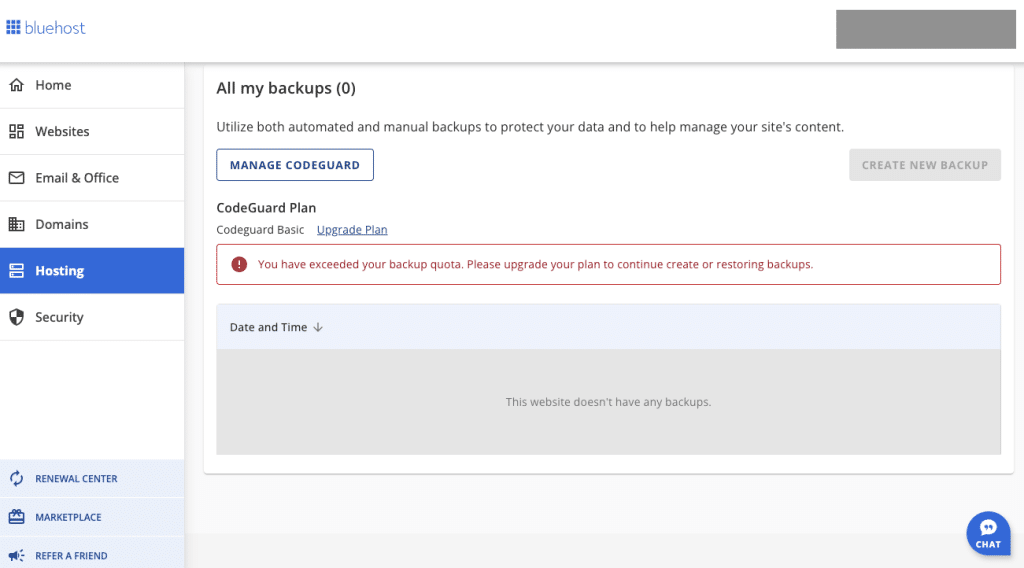
Cheap web hosting services often don’t offer any backups.
One of the biggest oversights with budget hosting is backup failure; either the provider doesn’t offer regular backups at all, or they limit backup storage so tightly that it becomes functionally useless. Sometimes, users don’t even realize they’ve run out of space for backups until they go to restore their site and find out that there’s nothing there.

Sometimes a lack of backups is hidden in the fine print, like this example from web hosting service GoDaddy.
Why this matters: If your site is hacked, held for ransom, an update breaks your theme, or someone deletes a key page by accident, backups are your only safety net. Without them, you could lose everything.
2. Slow Server Speeds
Cheap hosts often overload their servers with hundreds or even thousands of websites. When server resources are spread too thin, your site’s speed takes a hit. Or, if your website requires a lot of resources and gets a lot of traffic, you may be asked to upgrade to a different plan or different server situation.
Why this matters: A slow site drives away customers and kills conversions. Google also uses page speed as a ranking factor, so poor hosting can actually damage your SEO.
3. Shared Resources With Risky Neighbors
Most budget plans use a shared hosting model, where you share resources and IP addresses with other sites, and not all of these are genuine. Some of these can be spammy or malicious.
Why this matters: If another site on your shared server gets blacklisted by email providers, search engines, or security tools, you could be affected too. Plus, if their site uses too many resources, your site slows down or goes offline too.
4. Lack of Support
With a low web hosting price tag, there’s not much room for reliable support. You might be stuck with email-only support, long response times, or outsourced reps who can’t go beyond scripted answers.
Why this matters: When your site is down, you need fast help from someone who understands hosting. A business site that’s offline for hours could lose customers and revenue.
5. Hidden Fees for Basic Features

Though the 100 GB of disk storage offered in GoDaddy’s Terms of Service is generally enough for most sites, the wording of an “unlimited plan” with clear limits shows how important it is to look into web hosting services’ promises closer.
Some low-cost providers lure you in with rock-bottom pricing, but then charge extra for things that should be standard—like SSL certificates, domain privacy, or email accounts.
Why this matters: Over time, you may pay more with a “cheap” host than you would with a high-quality managed host that includes everything upfront.
6. Outdated Technology and Poor Security
Budget hosts may run outdated server software, like older PHP versions or insecure control panels, and fail to invest in things like firewalls or malware scanning.
Why this matters: Old server tech creates major security holes. If your host isn’t updating their technology, your site becomes an easy target for hackers.
7. No Staging Environment
A staging site lets you test changes in a copy of your site before pushing them live. Most cheap hosts don’t offer this feature.
Why this matters: Making changes on your live site, like plugin updates or redesigns, without testing first can break your site or disrupt customers.
8. Unreliable Performance

If your website needs more resources than a cheap web hosting service provides, you might be required to upgrade to a different plan or suffer slow-downs.
Cheap hosting often comes with vague promises like “99% uptime,” but that still allows about 7 hours of downtime per month. Without real uptime monitoring or server redundancy, outages are common.
Why this matters: Every minute your site is down, you’re losing visibility, trust, and possibly revenue. For eCommerce and service-based businesses, uptime is critical.
9. Limited Scalability
Entry-level plans don’t grow with your business. As your traffic increases, your site may slow down or crash—unless you upgrade to a more expensive plan or migrate to a new host entirely.
Why this matters: Moving a site between hosts is technical and time-consuming. Picking a scalable provider from the start saves time, money, and hassle.
10. Poor Email Deliverability
Some cheap hosts don’t configure email servers properly, or they bundle your domain email with a shared IP that has a bad reputation.
Why this matters: Your business emails may end up in spam folders or not be delivered at all. If you send quotes, invoices, or confirmations, that’s a major problem.
Get a Web Host That Works
For many small businesses, blogs, or small organizations, cheap web hosting can work fine, as long as you’re aware of the risks and take steps to mitigate them (like setting up backups). For larger businesses or those that wish to grow, cheap web hosting can create obstacles and frustrations down the road; a lack of security updates, backups, bandwidth bottlenecks, extra costs for third-party tools, and more. If you want your website to be a vital part of your business, it’s important to set it up on solid ground with a reliable web host. If you have questions about web hosting or you’re wondering about switching to managed hosting, contact us. We provide managed hosting services and support for hundreds of Michigan businesses, and we’re happy to help.